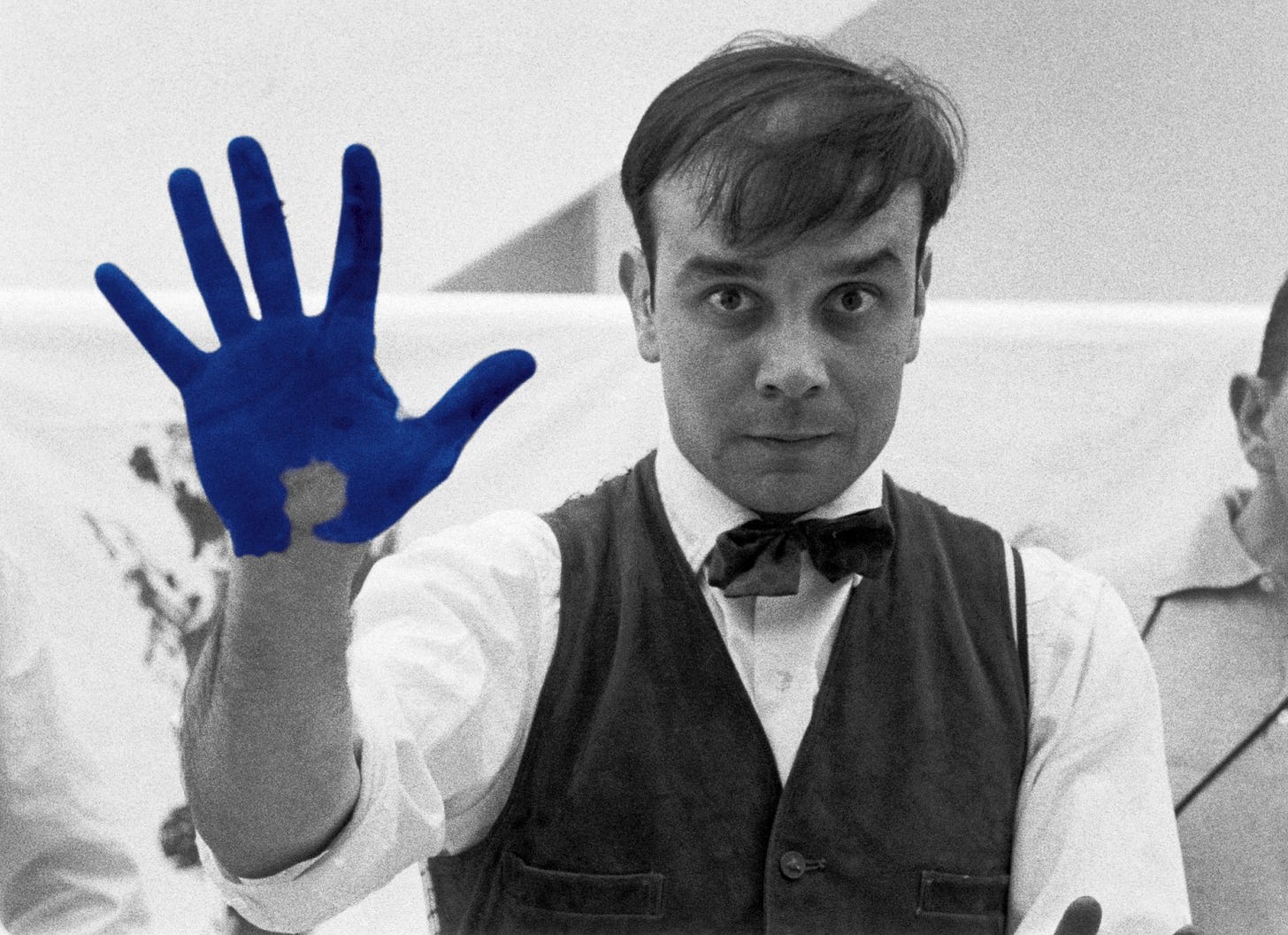
Yves Klein (1928–62) believed that by looking into blue one could encounter divine unity and absolute nothingness. He patented his own paint, International Klein Blue (IKB), and set out to paint the world in it.
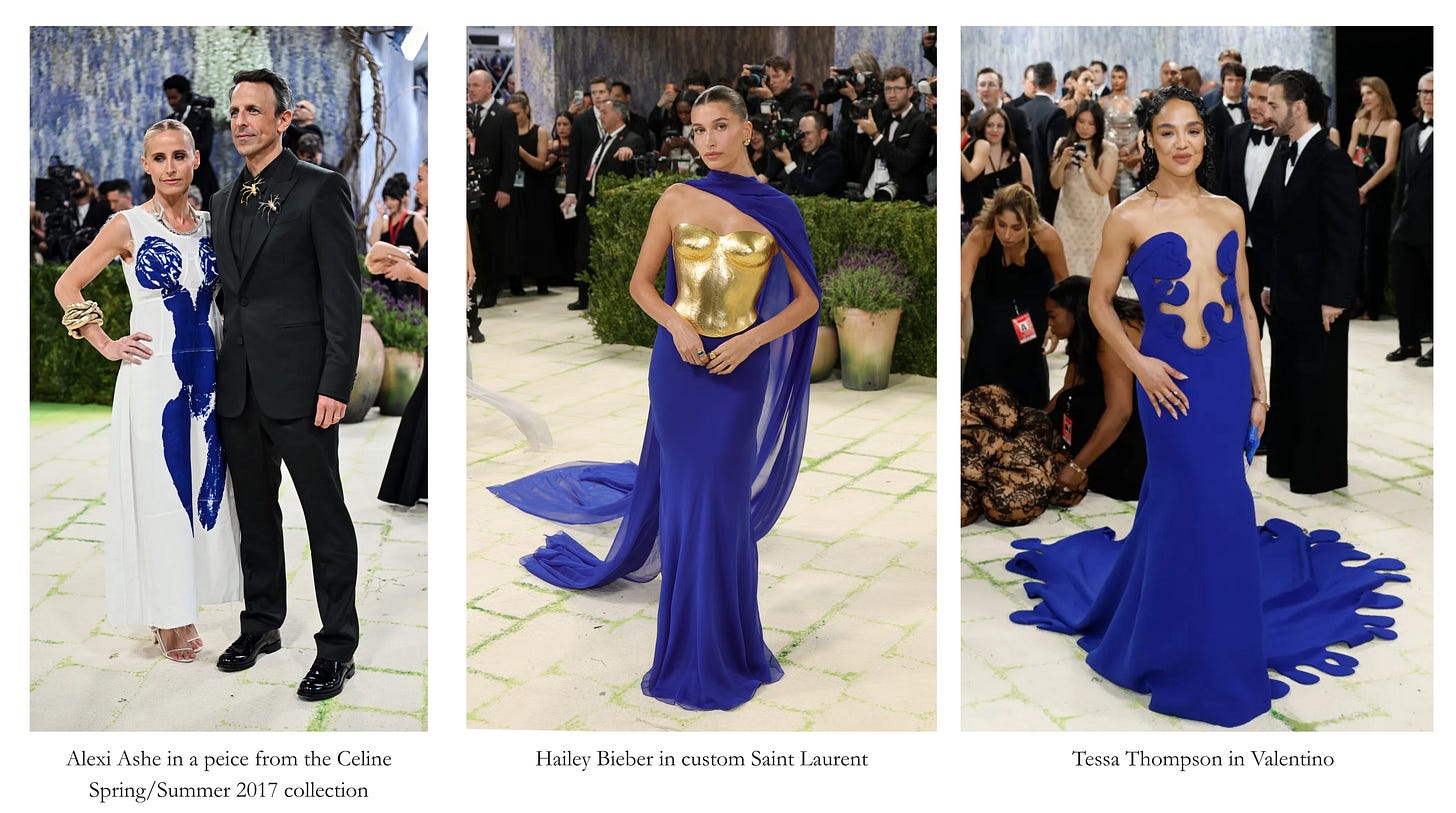
He did a pretty good job. There are now songs about it (Manic Street Preachers, Roger Eno…), films about it (Derek Jarman's final film), and it is on the cover of every book published by Fitzcarraldo. In 2026, IKB is having a fashion moment and appearing on runways and the Met Gala red carpet, worn by Hailey Bieber, Tessa Thompson, Alexi Ashe and others. The theme was "Fashion as Art". Ironically, Klein intended IKB to be neither.
As teenagers, Klein and his friends lay on the beach and divided the world between them. Armand Fernandez, who would also become an artist, chose the earth. Claude Pascal, a future composer, chose words. Klein chose for himself the air, the ethereal stuff surrounding the earth.
In 1946, while still an adolescent, I was to sign my name on the other side of the sky during a fantastic 'realistico-imaginary' voyage. That day, as I lay stretched upon the beach of Nice, I began to feel hatred for birds which flew back and forth across my blue sky, cloudless sky, because they tried to bore holes in my greatest and most beautiful work. — Yves Klein
The luminous blue sky above Nice ignited Klein and propelled him forward in pursuit of the depth and colour of the sky and the metaphysical beyond. Arman says of this time: "With this famous symbolic gesture of signing the sky, Klein had foreseen, as in a reverie, the thrust of his art from that time onwards — a quest to reach the far side of the infinite."
What is it about the blue sky? Klein later recited a passage from Air and Dreams (1943), in which Gaston Bachelard voiced the words Klein searched for to express that 'realistico-imaginary' voyage. He writes that the blue of the sky offers the mind no boundaries to push against or surface to rest upon, so the imagination keeps expanding indefinitely. We may lose ourselves in the feeling of the limitlessness of it, and in our reverie, voyage beyond all that which we know, into something metaphysical. "There is an imaginary beyond, a pure beyond, one without a within. First, there is nothing, then there is a deep nothing, then there is a blue depth."
Lapis Lazuli and Ultramarine
The Latin ultra-marinus means "beyond the sea", and, to the Romans, that is where the pigment came from — Afghanistan. Lapis Lazuli was mined in the Afghan mountains and transported to Persia, Egypt, Mesopotamia, Ancient Greece and Rome. It was used for jewellery, ornaments and ritual. Egyptians believed that it could lead the soul into immortality; they placed it in tombs to grant their dead a place among the gods in the afterlife. The Greeks and the Romans associated the stone with the goddess of love. Pliny the Elder called it "a fragment of the starry vault of heaven".
Lapis Lazuli powder yielded an ashy blue pigment. Then, in the 13th century, Arab scholar Ahmad ibn Yusuf al-Tifashi documented a method of processing it to get a vivid ultramarine. Florentine artist Cennino Cennini called this new shade "illustrious, beautiful, and most perfect, beyond all other colours". The complicated, labour-intensive method made an already expensive material even more so, and by the Renaissance it cost as much as gold and a hundred times more than other pigments on the market. Patrons would specify which parts of a painting they wished to be painted ultramarine, and displayed their devotion to the Virgin Mary (and their vast wealth) by painting her robes with this expensive, luminous blue. Ultramarine retained its sacred and financial prestige until the French chemist Jean-Baptiste Guimet created a synthetic version in the 1820s.
IKB
What pleased me above all were pure pigments in powder form… It is quite dismaying to see this same pigment, when milled in oil, for example, lose all its brilliance, all its essential vitality. — Yves Klein
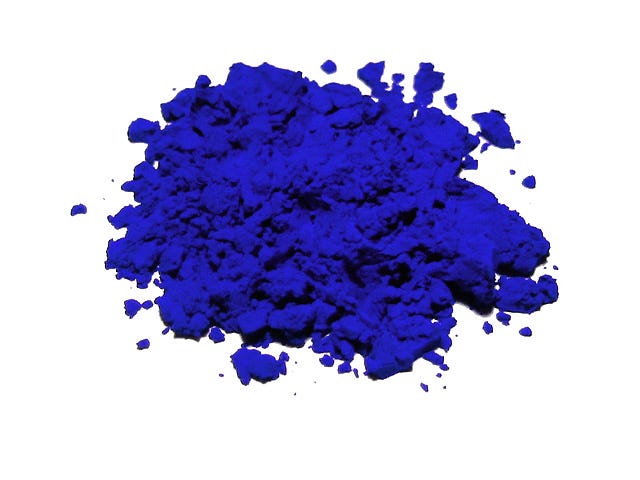
When light hits ultramarine pigment, some of it bounces off, some of it is absorbed, and some of it bounces off the surface beneath, interacting with the pigment for a second time before entering the viewer's eyes. This gives it a luminosity that other colours do not have.
To make paint, pigment must be mixed with a binder. Traditionally, binders comprise mostly oil. These oil binders coat the pigment in a reflective surface that can make the colour look dull. They do further disservice to the colour by breaking down and going opaque over time.
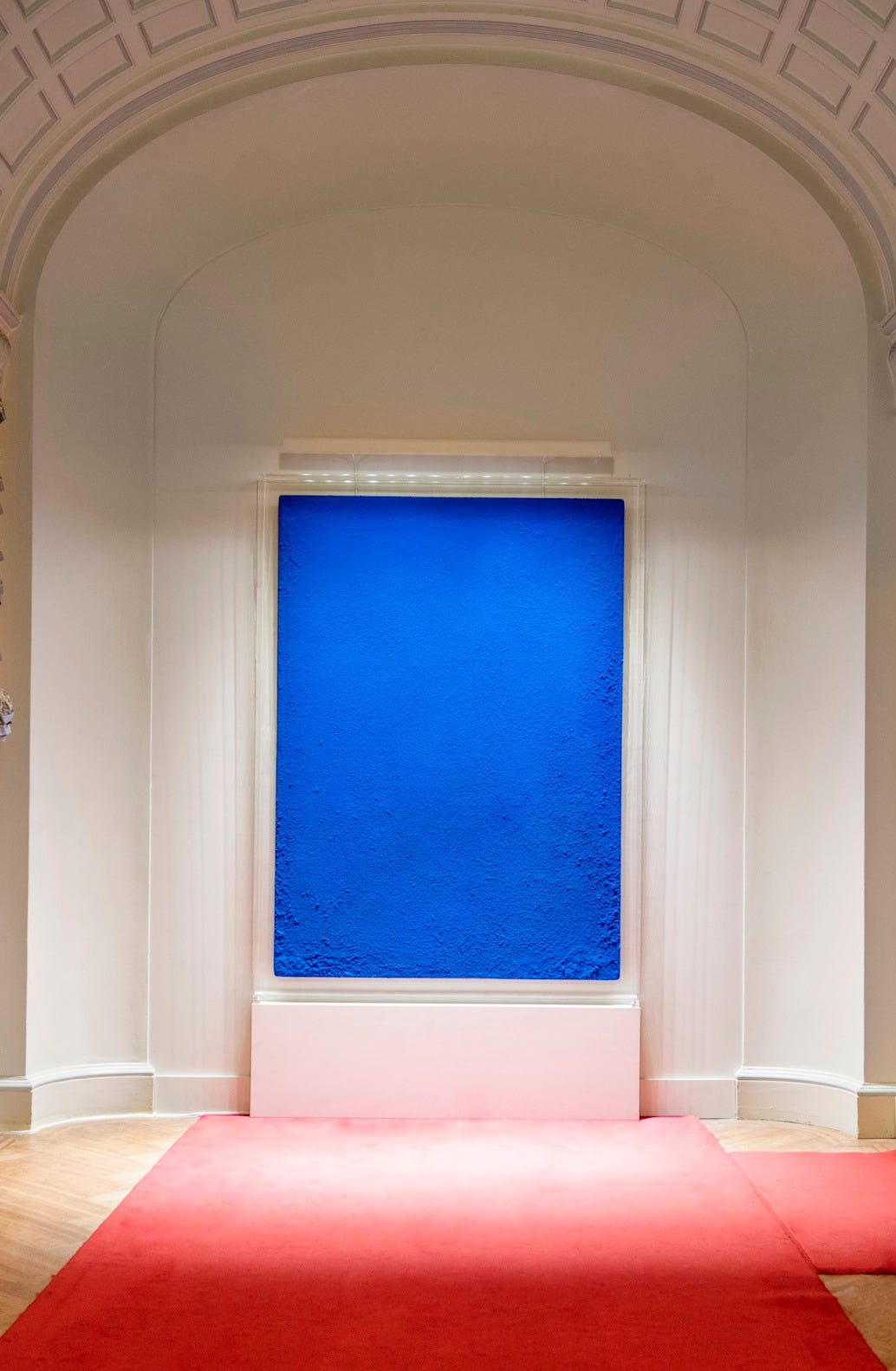
Klein sought to liberate the incandescent pigment from the imprisoning effect of heavy binders by creating a paint that would preserve the luminous colour of ultramarine. Collaborating with Parisian paintmaker Edouard Adam, he developed a synthetic binder. This binder, polyvinyl acetate, shrinks as it dries to the point of almost disappearing, but leaves behind just enough substance to hold the pigment particles loosely in place. The matte finish looks like raw pigment powder, and it allowed Klein to paint with "the most perfect expression of blue." Klein patented it in 1960 as International Klein Blue (IKB).
To sense the soul, without explanation, without words, and to depict this situation — this, I believe, is what led me to monochrome painting. — Yves Klein
Klein believed in paintings as objects of contemplation rather than representation. He believed that painting free from restrictive lines could provoke some response of the imagination and offer a path to freedom from imposed ideas. By being "immersed in the immeasurable existence of colour," one could bask in the infinite spiritual space he believed to permeate all things.
In 1955 and 1956, Klein displayed monochrome paintings of various colours. The audience interpreted the bright yellow, orange, and pink canvases as decorative things. Klein was not happy with this interpretation. As a response to this misunderstanding, he henceforth decided to focus solely on blue, the colour of the sky and the sea.
He said of blue: "Blue has no dimensions; it is beyond dimensions, whereas the other colours are not. All colours arouse specific associative ideas, psychologically material or tangible, while blue suggests at most the sea and sky, and they, after all, are in actual, visible nature what is most abstract."
In Milan in 1957, Klein presented his show Proposte monocrome, epoca blu. Eleven suspended blue monochromes appeared to levitate in the Apollinaire Gallery. All the same shade: IKB. This way, they would not be so inclined to compare and arrange. The audience had nowhere to look except into the blue. Pierre Restany wrote in the introduction to the exhibition: "What these monochrome propositions demand of you is that fragment of receptiveness which can make revolutions and bring down tyrants". He means no prior knowledge is required, only a willingness and openness to see and experience, and perhaps the courage to suspend the ego. The canvases were not to be seen as things but rather as vessels for experience. Klein wanted his audience not to be an audience, but to fall into the blue and "bathe in a cosmic sensibility" — in the raw capacity for experience itself.
Judo, Zen and Rosicrucianism
Klein was a black belt yodan Judo master and spent two years in Japan teaching judo. He said, "Judo helped me to understand pictorial space and the discovery of the human body in spiritual space". In Japan, he studied Zen Buddhism. Central to Zen is the concept of mu. It translates as "no", "not", or "nothing", but the word is really a vessel for what cannot be articulated or understood intellectually. Mu neither affirms nor denies; it is neither presence nor absence. Mu may be found when judgment and thinking fall away, when nothing remains, and then one's conceptual idea of nothing falls away. Mu is in the empty space. Rinzai Zen practitioners may focus not on thinking or analysing mu, but on embodying it.
Klein's mother, Marie, introduced him to the esoteric mystical tradition of Rosicrucianism, and he became obsessed with its central text, Max Heindel's The Rosicrucian Cosmo-Conception. Heindel writes that imagination is a sixth sense and, when trained, can be used to achieve the spiritual fulfilment and inner peace that Rosicrucians seek. He claimed blue to be superior to all the other colours, that it is the colour of the spirit freed from the material world. Marie also believed that viewers could enter the spiritual world through the colours in her work.
Zen and Rosicrucianism both fed Klein the idea that beyond the material world lies something more, something vast, open — what he called "the void" — and that one can experience this. For Klein, the void is full of spiritual and cosmic energy. This contrasts greatly with Jean-Paul Sartre's bleak existential void: one of meaninglessness, angst and dread (Being and Nothingness, 1943). Klein's void is one of not despair, but freedom, "pure sensibility", of mu.
I have chosen as my ally the palpable space of the boundless universe. — Yves Klein
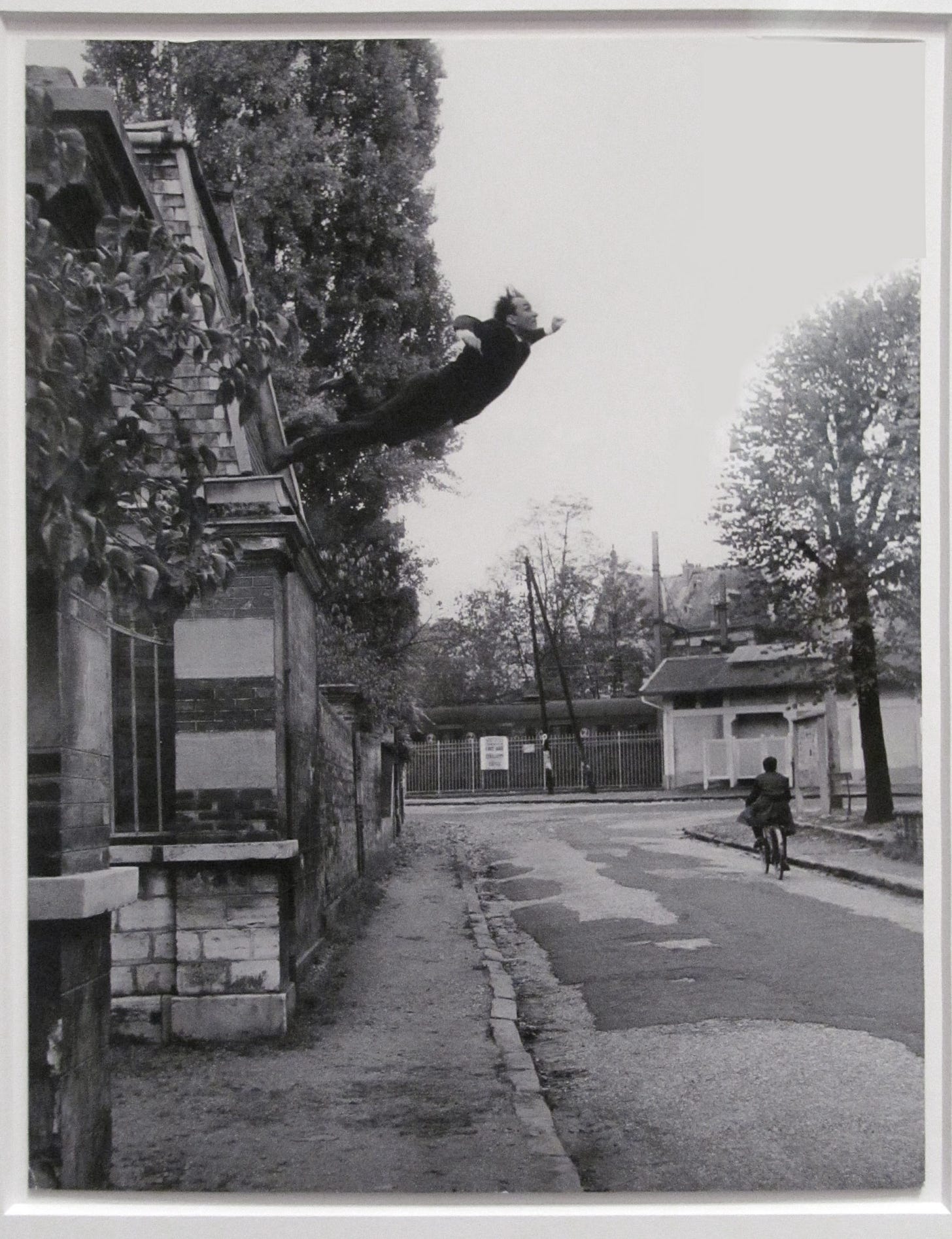
In his experimental photograph, Le Saut dans le Vide (The Leap into the Void), Klein appears to leap from a second-storey window, in a way that seems to be an act of freedom rather than defeat.
The Earth is Blue
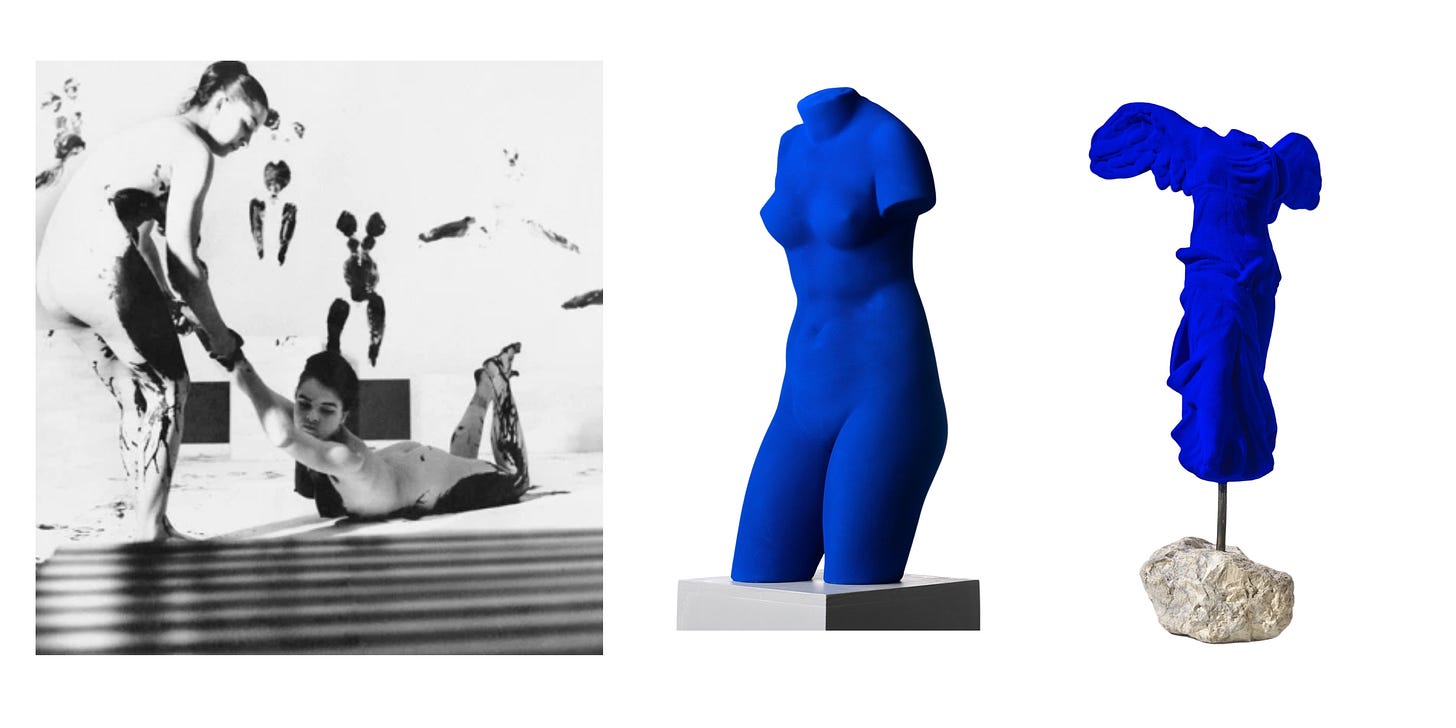
Klein had naked women cover each other in IKB and drag each other across canvases as "living paintbrushes". He painted sculptures in IKB; replicas of the Venus de Milo and the Winged Victory of Samothrace, casts of himself and his friends. He desired to show that blue pervades everything; it is the material form of the infinite. He painted a sculptural globe with IKB and declared, "The Earth is blue."
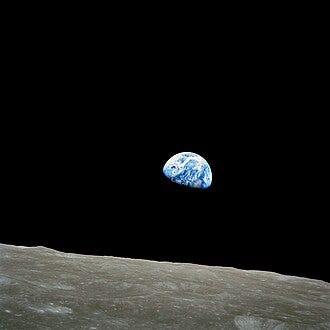
Four years later, Yuri Gagarin, the first human to leave Earth and see the world from afar, reported: "The earth is blue, how wonderful. It is amazing."
IKB & Me
When I look at a Klein monochrome, I am reminded of how I feel when I look up to the sky and try to imagine what lies beyond everything I can see and imagine and beyond things I can't see and can't imagine. I don't love this feeling — but perhaps that is my ego getting in the way.
I can interact with IKB in a way that I can't do so with the subjects in the paintings of Klimt, Cézanne, Rembrandt or whoever else. Their subjects — people, objects, and landscapes — are either long dead, lost or changed. Klein blue has no subject. It does not represent the sky or the sea. It represents nothing. It is just what it is. And it will always be alive and luminous.